
Groundwater Governance Failure in Western Yolo County
"Is this year worse than the others Or just part of the trend" Tarin Breuner.

The expansion of irrigated agriculture onto previously unirrigated lands in the Hungry Hollow and Dunnigan Hills in western Yolo County, represents a fundamental failure of groundwater governance. This failure did not begin with any single decision — it accumulated over more than a decade of landownership exchanges, permissive well-permitting approvals, and regulatory ambiguity, transforming Yolo County’s agricultural landscape.
The process began in the early 2010s, when the county approved virtually all requests for high-capacity agricultural wells on lands with and without access to surface water canals. Over time, these landowners established a history of groundwater use, joined the surface water irrigation district, and invested in canal infrastructure. Through conjunctive use contracts, they received surface water nine out of ten years, with their wells reclassified as backup sources — permitted only during scarcity years when the district cannot meet demand from surface supplies.
California Water Code §10727.4 allows and encourages conjunctive use practices, by requiring groundwater sustainability plans to address, where appropriate, “activities implementing, opportunities for, and removing impediments to, conjunctive use or underground storage.” But the statute’s intent is conjunctive management to reduce overdraft — not to open new irrigated lands.
On its face, this arrangement appears responsible. But the reality experienced by long-term farming families in Hungry Hollow tells a different story. The Hungry Hollow area has been designated a Yolo Subbasin “Area of Special Concern” by the Yolo Subbasin Groundwater Agency (YSGA), owing to a documented trend of declining groundwater levels. These families have lived through roughly three drought years out of every ten — conditions that would lead traditional farmers to fallow fields of lower-value crops.
Under the business model now dominating the region, the land fallow option is no longer available. Corporate managers operating perennial crop plantations — almonds, pistachios, vineyards, olive groves — will pump so long as there is a return on investment. Almonds alone require approximately four acre-feet of water per acre per year, and high-volume pumps impose accumulated pressure on the aquifer.
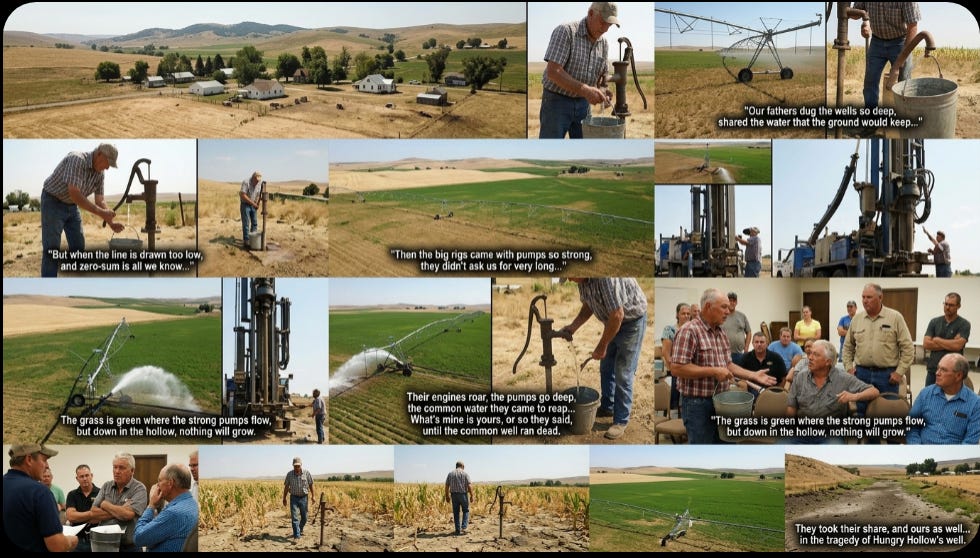
In the past year, four wells were drilled on the Cobram Estate property formerly known as the Williams Ranch — land that was historically dry-farmed or fallowed, that is now opened to groundwater irrigation for the first time. Cobram’s permits qualified for a conjunctive use contract arrangement, premised on replacing groundwater extractions with surface water. But two-thirds of the parcel has no history of irrigation and cannot qualify for surface water exchanges, under any honest reading of that framework.
Extending conjunctive use to these lands does not substitute surface water for groundwater — it underwrites the opening of entirely new irrigated acreage. The Boundary Bend/Cobram wells were classified as replacement “in-kind” wells, a classification community advocates have called a mistake, but ratified by a 3-to-2 majority of the Yolo County Board of Supervisors on April 8, 2025.
SGMA was enacted to halt unsustainable groundwater use and bring basins into balanced levels of pumping and recharge, explicitly identifying long-term groundwater-level declines and permanent loss of aquifer storage as “undesirable results.”
Since 2013, out-of-county LLC entities have been acquiring large tracts of land in the Yolo Subbasin, attracted by the prospect of growing almond and pistachio orchards where groundwater tables are shallower and land costs have historically been lower than in the San Joaquin Valley. Many of these SJV corporations have migrated their future orchards to the Sacramento Valley. These changes in landownership affect the relationship between agriculture and the land.
The plantation model — characterized by absentee ownership, automated agronomic practices, and specialist contractors managing water, soil, and pest pressures — has no place for a farm family, no dwelling anchoring the land to a broader community purpose. The relationship with the land is transactional.
That transactional logic has real ecological consequences. Research on California’s Central Valley groundwater sustainability agencies found that GSAs with more than 60 percent of agricultural land in perennial crops — including almonds, pistachios, and walnuts — accounted for 76 percent of total agricultural water use within those agencies and will likely face greater vulnerability to prolonged drought due to the high cost of fallowing productive orchards.
In August 2025, the Yolo County Board of Supervisors adopted an urgency ordinance imposing a temporary 45-day moratorium on new agricultural well permits in the YSGA’s designated Focus Areas — later extended through August 2026 — to allow time to better understand the impacts of land use change and the hardening of groundwater demand.
This is a meaningful step, but a moratorium alone will not resolve the underlying structural failure: a well-permitting regime that allowed new irrigated acreage to be established before the regulatory tools existed to assess cumulative impact, and a conjunctive use framework being applied in ways that bear little resemblance to its statutory purpose.
SGMA promised something different. Groundwater sustainability agencies are required to achieve sustainability within 20 years of implementing their plans; avoiding undesirable results including significant groundwater-level declines and permanent loss of aquifer storage. Whether that promise is kept in western Yolo County will depend on the county Board of Supervisors, the YSGA Board, and the State’s Water Quality Control Board — willingness to apply SGMA’s intent to undo decisions already made on the ground.
Lack of Rain

It’s been a hot winter
Words that shouldn’t go together
As though a calendar
Can control our weather
The snow is disappearing
The rain hasn’t come
Our backs are breaking
In the heat of the sun
What can we ask for
What can we do
The later it gets
The grimmer the news
Is this year worse than the others
Or just part of the trend
Toward a struggling earth
Toward a faster end
Please to the sky
For the love of the ground
We must collect
We must rebound